
KarenJane
Circles
Complete the circle.
Consider every task, each routine, all your interactions as circles.
Most of us are great at beginnings, pretty good at middles but don’t necessarily manage our endings.
It is often our failure to close the circle that allows clutter to creep into our lives and homes.
We bring in the mail, we may even sort through it but we fail to complete the circle when we don’t pay the bill when it’s due, or respond to the invitation or make the appointment.
We do the laundry, get things folded and stacked up but never quite get it back in the closet.
We carry our dirty dish in from watching the movie, set it on the counter, but fail to put it into the dishwasher.
Someone does something kind or generous for us, we appreciate the gesture, but never thank or acknowledge them.
Take it out. Use it. Put it back.
Open it. Read it. Respond, recycle or shred it.
Converse. Pay attention. Respond with kindness.
Pay attention to your endings.
Complete your tasks and transactions.
And when the circle is complete, move on.
It’s your one Big Life.
Make conscious choices.
Karen
Repurposing our inheritance
What’s sentimental and sacred differs from person to person.
We know our possessions hold only the meaning that we assign them.
Inherited items present their own challenges.
How best to honor the person, keep their memories alive and yet not be overwhelmed by what they’ve left you?
Even when we decide what things to keep, figuring out how to incorporate them into our homes can be tricky.
Maybe the piece of furniture fits neatly into your living room, or the picture looks nice in the hall way.
Other items might be more difficult, especially if they aren’t particularly useful or attractive.
If it is important enough to have saved, then don’t just pack it up and stack the box in your garage.
One option is repurposing the items or displaying them in a more creative way.
I only chose a few things from my mother’s estate.
Although I knew I’d never use her china tea cups, nor would I display them neatly on a shelf, I knew that she had, and that they had been special to her. Enter my hammer, glue and box of grout.
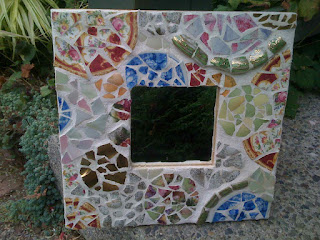
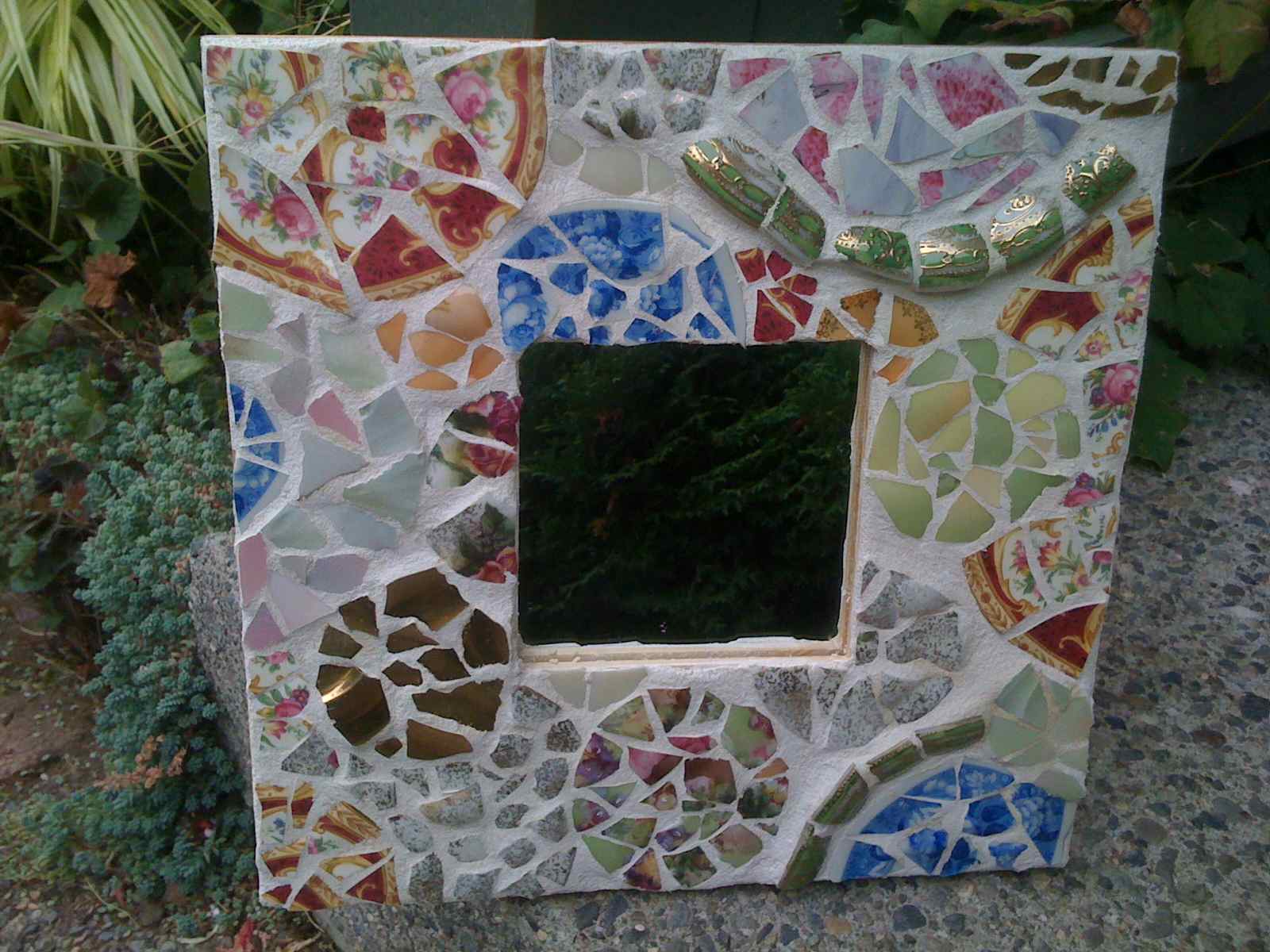
Now I have a mirror that I display in my home that is a wonderful reminder and visual presence of her and the cups.
(I had enough pieces to make one for each of my sisters, who chose not to take
any of the cups)
I have a friend who took her grandmother’s antique beaded purses and put them in a shadow box that hangs in a grouping with old photographs.
And a client who took her Dad’s collection of marbles out of their cloth bags, poured them into tall, clear vases, and is now using them as book ends.
It’s the memories and connections to the people that matter, not their stuff.
Choose things of theirs that resonate in your heart and bring to mind funny, touching moments you shared.
Add those pieces to your home with care and thoughtfulness.
Karen
If you need some ideas or inspiration for how and what you could repurpose, or if you just want to see some clever and imaginative projects, check out these web sites:
Four simple sentences
Relationships are challenging.
Dealing with co workers, living with people, dealing with family, and maintaining friendships all require time, patience and a willingness to be present.
Our lives and emotions, thoughts and reactions are complicated.
As Gold Medal Conclusion Jumpers, it is easy for many of us to misjudge another’s reaction or behaviors.
In an effort to declutter our relationships, I invite you do get familiar with and practice these four sentences.
I’m sorry.
I was wrong.
I need help.
I don’t know.*
As opposed to making us seem weak or vulnerable, these offer the chance to connect in more meaningful ways, resolve problems, diffuse tension and move communications to a place where there is greater understanding and a true exchange of ideas and solutions.
Choosing to honestly communicate is a powerful tool in an authentic life.
(Even if it’s scary…….)
You get to choose.
Karen
*Louise Penny
Fewer. Less. Smaller.
Keep it simple.
The fewer steps,
the less you have to think,
the smaller the area you have to clean and maintain,
the more limited your choices,
all make your life easier.
Avoid making your systems too complicated.
Every additional step in a process makes it exponentially less likely that you’ll follow through to completion.
Make the habits of daily living routine and no brainers.
Use hooks instead of hangers.
Don’t put something down, put it away.
Take advantage of on line bill paying.
Put your dirty dish into the dishwasher; don’t just set it on the counter.
Own fewer things of higher quality-which means less shopping and less maintenance.
Organize like items together.
Store things where you use them.
Practice saying ‘No’.
Choose to simplify the tasks you can control and make your life easier.
And then choose something fun to do this week!
Karen
Irritating…..
Bugs me lots.
Clutter is irritating.
If you choose one space in your house that’s cluttered, you’ll come up with a ‘Bugs Me Lots’associated with it.
For example: Piles of shoes in the bottom of your closet. The Bugs Me Lots would be that it takes you extra time every morning while you dig through the clutter to find the shoes you want to wear. Or it bugs you when during the search you find shoes you forgot you had.
Or
Paper clutter on your desk. It Bugs you Lots that things get put down, more papers get put on top of them and you lose or misplace things that are time sensitive and important.
Sometimes it’s such a small thing or you’ve become so used to the situation you’re not even aware of the constant irritation.
Pay attention. Listen to your own internal talk. Hear the dialogue in your head concerning spaces in your home that don’t feel or look right to you.
Change will happen when you decide you’ve had enough being Bugged.
Make some other choices.
Decide how you really want to use that space.
Spend the time to sort, prioritize and organize an area that is irritating you.
Remove everything from that space that doesn’t support that use.
Spend time organizing the area in a way that makes sense to you.
Arrange easy access to what you want, need and frequently use.
Choose one place in your house that gives you that Bugs Me Lots feeling.
Spend some time this week decluttering and organizing it.
You’ll be relieved, I promise.
Here’s to less Bugs and more calmness.
Karen
Cost and value.
Everything has a price.
And free things are often more expensive than you realize!
(Consider the clutter created by the give away items you brought home from the last conference or trade show…..)
In trying to have a less clutter but knowing you want and need things in your life, paying attention to the cost and value of an item is important.
We usually think of cost in terms of how much money we spent, but that isn’t the whole story. In addition to the dollar amount there are the time, space, maintenance, and emotional costs we pay for our things.
We need to carefully weigh those costs-obvious and hidden, against the value we receive. Is it valuable to us to be able to find things when we need them? Do we value having spaces in our homes dedicated to activities we enjoy? Does it add value to our relationships to be able to spend more time with the people we love and care about, instead of more time working to pay for things we rarely use, or purchased out of guilt or obligation?
Where in your life are you paying a price; wasted time, actual cash, under utilized or over crowded space, and not receiving adequate value?
By pausing and considering what and who you truly value in your life, and being willing to pay the cost to make the time and space to have those things; life will be less cluttered and yet fuller and richer.
Take a few moments this week to consider areas in your life where the cost /value ratio might be out of balance. Be willing to pay the price and afford the costs of decisions that will make your life easier, and more in keeping with what you love and value.
Your choices.
Your results.
Your life.
Karen
Stuff you own.
This week’s idea: Stuff you own and Stuff that owns you.
There is a fine and sometimes blurry line between the items we own and those items we feel own us.
The things that bring us joy and pleasure, the accessories in our homes we enjoy, the tools and products that make the tasks of daily living easier, the clothes we look good and feel great in, the gifts that have meaning, and those things that remind of us of people and places that are dear to our hearts. Those are the things we own.
The items we’re keeping out of guilt or obligation, the things we bought on impulse, the toys the kids don’t play with that are spread throughout the house, the equipment or supplies for hobbies we no longer choose to have time for or interest in, but we’re unwilling to let go of. Those are the things that own us.
Take a moment or two and do a quick review of a place in your home that feels cluttered or less organized than you’d like. How many things in that room fall under the heading of owning you?
Could you let some of them go? Are you willing to trade a few moments of discomfort, regret or embarrassment over having held onto to something beyond your use, need or interest?
Would opening up that space make a difference in how you feel about and use that area?
The things in life we feel good about having, we don’t mind taking care of, or finding places for them to live. We are making conscious choices about what’s important to us.
Just like we don’t want to give space in our house to store Justin Case’s things, we don’t want to feel owned by our possessions.
Your choices.
Your results.
Your life.
Choose wisely.
Karen
This week’s idea. Verbal clutter.
There’s physical clutter, mental clutter, emotional clutter and for many of us there is verbal clutter also.
Gossip. One upping. Playing the devil’s advocate. Chattering on to fill what we perceive to be uncomfortable silences. Getting in the last word. Arguing to prove an unnecessary point. Sarcasm. Exaggerating for dramatic effect.
There is a concept in Buddhism; Wise Speech.
It asks us to consider before we speak, Is it true and is it helpful?
It is not that our speech is filled with lies, more likely we are only considering things from our own point of view.
And even if what we are about to say is technically true, will saying it help the situation?
Just as we rethink our possessions in order to have less clutter in our lives, and more room to live the life we truly want; pausing before we speak may prevent us from verbally cluttering our relationships.
We may experience ourselves as being kinder and more patient as we communicate with family, friends and colleagues.
No one will ever see the bites marks in your tongue. However, you will have fewer conversations where your lips engaged before your brain, or been right when you could have been kind.
Our speech, our buying habits, what we choose to find space for and honor in our lives: It is all about making conscious choices.
Walking our talk.
Your choices.
Your results.
Your life.
Karen
Maps, melted Chapstick, pencil stubs…
What else is lurking in your car’s glove compartment?
Probably not gloves!
Clutter and disorganization isn’t just in our houses.
It can spill over into our cars too.
You might not be up for tackling the entire interior of the car, but you could take ten minutes to sort through the hidden accumulation in the glove compartment.
Grab a trash bag, your recycle container, and something to put ‘things that live somewhere else’ and open that treasure box up.
Wow, who knew you could stuff so much stuff in such a small space?
Dried up pens, napkins, a dead flashlight, lost sunglasses, receipts from tires long worn out and replaced.
Having removed everything, down to the last paper clip and mustard packet; take a moment to review what you unearthed.
In addition to the car registration, proof of insurance, and the car manual what items belong and need a home in that space?
What supplies, tools or accessories need to be close at hand and available?
What might still need to be in the car but could live in the trunk or a seat back pocket?
Think about why some of the stuff ended up in there and how you might deal with those items in the future.
Will having a clean and organized glove compartment necessarily have a huge impact on your life? Probably not.
But decluttering that small space is great practice. It reinforces the habits of being organized and gives you one more place in your life where you know what lives where, so you’ll be able to find it when you need it.
All those individual projects add up, all those ten minutes of decluttering and organizing build on each other, and you experience the results of having a home (and car) that are easier to live in and maintain.
Your choices.
Your results.
Your life.
Karen
Nothing Is More Exhausting Than the Task That is Never Started.
Gretchen Rubin
The time and energy we spend avoiding a project, a difficult conversation, a tedious task or a necessary chore drains us.
How much mental energy do we waste telling ourselves stories, making up excuses, justifying our lack of action and motivation?
Feeling overwhelmed, unsure where to start or the best method, we fail to take any action. The situation doesn’t change and we feel stuck.
These are the opportunities to practice “little bites”.
Start with one small action.
Commit to spending ten minutes, not an hour, dealing with the situation.
Remind yourself of the pay off of doing the task.
Ask for help.
Decide if the project is something you want to do or feel you ‘should’ do. (Avoid shoulding on yourself)
One small step can often create the tiny bit of momentum needed to move you forward, and keep you rolling toward the results you really want.
Stop thinking, considering, pondering, rethinking, or over planning.
Make a choice and act on it.
Your life, your choices, your results.
Karen